A gray outdoor heat pump unit on a concrete pad beside a dark horizontal-siding wall, with a small electrical box on the wall, shrubs and a concrete walkway to the right at dusk.

No calling every shop in Geary County

Heat pump blowing cold air in Junction City, KS

A heat pump blowing cold air in the middle of a Kansas winter usually means it's stuck in the wrong mode, low on refrigerant, or the reversing valve has failed. This page walks through why it happens and what it means for your system. Instead of searching around Junction City, calling several companies and repeating the same explanation to each one, you can get matched with a local contractor who works on heat pumps year round and knows what tends to go wrong with them here.

Skip the calls

A heat pump that blows cold air in the dead of a Geary County winter is usually just doing what it was told. If the thermostat is stuck in fan-only mode, or set to "on" instead of "auto", you'll feel plain room-temperature air moving instead of heat. If the system is in heat mode and still feels cold, look at the outdoor unit. Heat pumps pull warmth out of outside air, and when it's near or below freezing, that air feels cold blowing through your vents even while the system works correctly, usually around 95 to 105 degrees at the register, warmer than the room but not hot like a furnace. A unit that's truly failing to heat, running nonstop, cycling oddly, or coated in ice with no defrost cycle kicking in, points to a bigger problem: low refrigerant, a stuck reversing valve, or a failed defrost control. That's a repair, not a thermostat setting.

A gray outdoor condenser unit on a concrete pad beside a house with gray lap siding, connected by conduit and refrigerant lines to a wall-mounted disconnect box, with a green shrub and mulch bed at left.

Running the way it should

This is a heat pump keeping up with a Kansas winter. The conduit and disconnect box stay connected and dry, the pad is clear, and warm air comes out of the vents on demand. Nothing about the outdoor unit calls attention to itself.

An outdoor air conditioning or heat pump condenser unit on a concrete pad beside a house with horizontal vinyl siding, a gray electrical disconnect box and conduit on the wall, and a concrete walkway in the foreground.

Something's gone wrong

Dirt built up on the coil like this blocks the airflow a heat pump needs to pull heat from outside air, even in January. An aging unit in this shape is more likely to lose refrigerant or strain a part trying to keep the house warm, and that's often when cold air starts coming through the vents instead.

Why does a heat pump struggle so much in a Geary County winter?

  • Winter nights average 21°F

    Overnight lows average 21°F here in December, January and February, so your heat pump is pulling warmth out of air that's already near freezing most nights.

  • Heat runs October through April

    Heat runs about seven months a year here, October through April, which means a reversing valve or defrost control gets worked hard and worn over time.

  • Cooling runs May through September

    Cooling only runs about five months, May through September, so the same system spends more of the year heating than cooling your home.

NOAA nClimDiv 1991-2020

A gray outdoor heat pump unit on a concrete pad beside a house with gray horizontal siding, with conduit and an electrical box on the wall and a shrub at left.

Why defrost cycles matter here

When outdoor temperatures sit near freezing, frost builds on the outdoor coil. The system runs a defrost cycle to clear it, and while it does, it shifts into cooling mode for a few minutes and the outdoor fan shuts off. Air coming from your vents during that stretch will feel cool, sometimes with a hint of steam from the outdoor unit. That's normal. It should last only a few minutes before switching back to heat.

An outdoor air-source heat pump unit with a dark grille stands on a concrete pad beside a white wall and wood-clad facade, surrounded by gravel.

What a failed reversing valve looks like

The reversing valve is what lets a heat pump switch between heating and cooling. If it sticks in the cooling position, the system will blow cold air no matter what the thermostat is set to, and it won't correct itself after a defrost cycle ends. This is a mechanical failure, not a setting, and it usually means the outdoor unit is running but the air inside never turns warm, even after twenty or thirty minutes.

Defrost Cycle or Stuck Heat Pump

Normal defrost

  • Cold air lasts two to five minutes, then switches back to warm once the outdoor coil clears.
  • You'll hear the outdoor fan stop and see steam or light frost melting off the unit during the cycle.
  • It happens most on nights near freezing, which in Geary County is much of December through February.
  • The thermostat display may show a snowflake icon or say "defrost" during this time.
  • Once it ends, air at the vents warms up again within a few minutes without you touching anything.

Stuck on cold

  • Cold air keeps coming for ten minutes or longer and never switches back to warm on its own.
  • The outdoor unit stays idle or runs constantly without the fan ever stopping for a defrost cycle.
  • The thermostat may still read "heat" while every vent in the house blows air no warmer than the room.
  • A low hum or clicking from the outdoor unit without the fan turning points to a stuck reversing valve.
  • Ice building up and staying on the coil instead of melting off means the defrost cycle isn't completing.
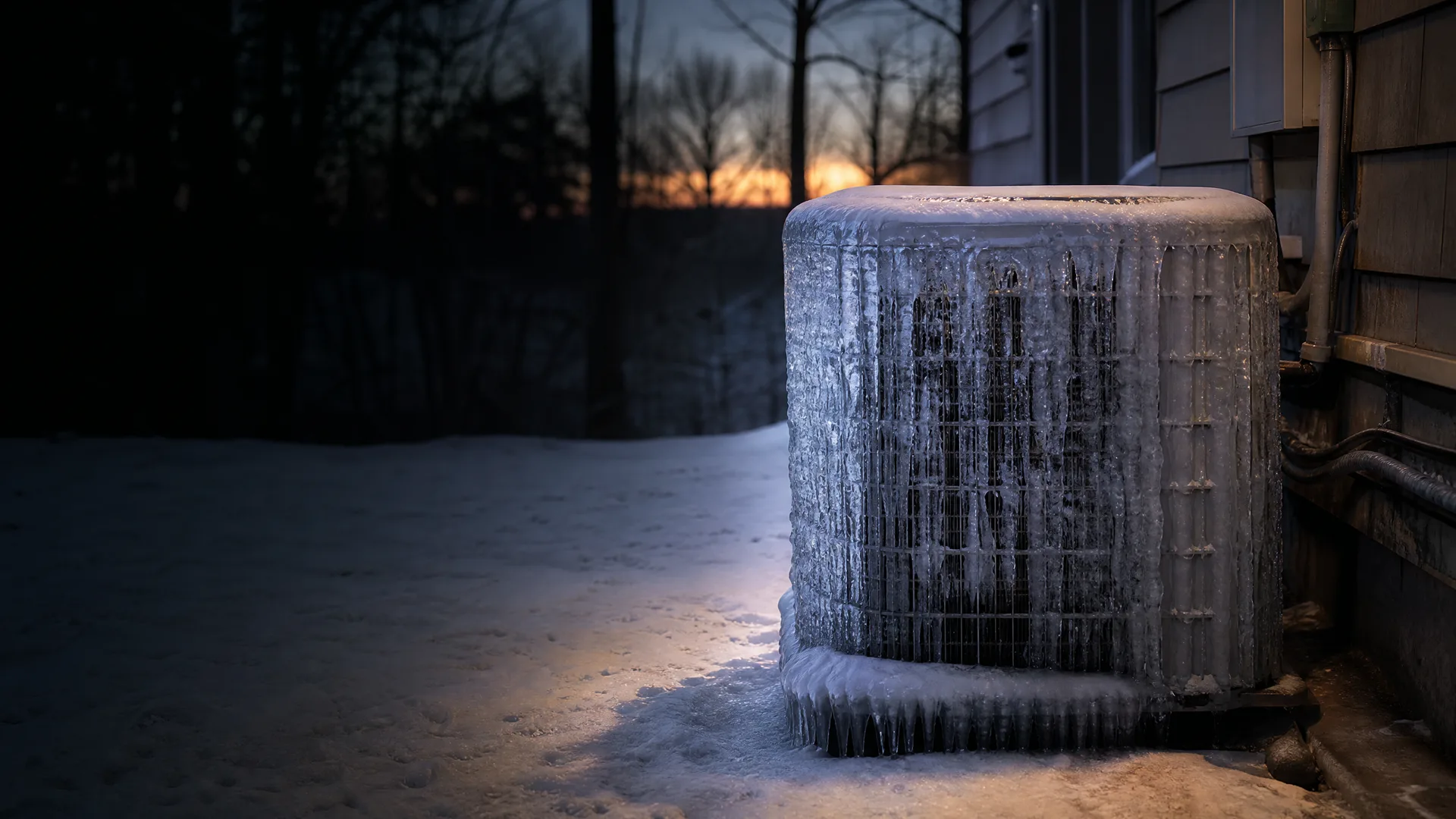
An outdoor condenser unit encased in thick ice stands on snow beside a house with horizontal siding and exterior pipes, with bare trees and a sunset glow in the background.

It's just past six on a January morning, still dark, and you go out the side door to check on the unit because the house hasn't felt right since yesterday. The outdoor coil is thick with ice, not the thin frost that melts off in a few minutes, but a solid white shell over the fins and most of the cabinet. The fan isn't turning. No steam, no drip off the pad, no sound at all. Geary County mornings like this sit in the low twenties, and the air coming through your vents has been running cool for hours. You crouch down and touch the ice. It doesn't give.


Is this cold air normal, or is something wrong

You'll notice it most at the register: air moving but no warmth to it, right when you need the house warm. Maybe the thermostat is calling for heat and nothing changes. Maybe the outdoor unit is running but the air inside stays cool for longer than a few minutes. You might hear the outdoor fan cycling oddly, or notice the unit hasn't switched back to warm air after what feels like too long. If this keeps up overnight in a Geary County cold snap, the backup heat may end up carrying the house on its own, and the people inside will feel the temperature drop before anyone gets a chance to look at the unit.

A woman in a knitted shawl sits in a living room with a fireplace, shelves, a sofa with cushions, and a lamp by a bright window, looking off to the side.
A woman with long brown wavy hair in a green shirt over a white top stands in a living room with built-in white shelves, a ceiling fan, a potted plant and a sliding glass door.
A woman with shoulder-length gray-streaked hair in a light gray knit sweater stands smiling and looking off to the side in a living room with a sofa, houseplant, framed picture, and sunlit sliding glass door.
A woman with shoulder-length curly gray hair wearing a gray knit sweater stands near a window with a sheer curtain, looking to the side, with a blurred interior room behind her.

One form, no calling around

A licensed pro who repairs heat pumps in Geary County gets your request.

You're not committing to anything by asking.

How a heat pump moves heat indoors

  • The reversing valve switches a heat pump between heating and cooling by redirecting refrigerant through a solenoid coil.
  • When that coil loses power or sticks, the valve can freeze between positions and send the system into cooling even though the thermostat calls for heat.
  • Refrigerant carries the heat indoors, so a system low on charge has less heat to deliver even when every other part runs correctly.
  • Low charge usually points to a leak somewhere in the line set or coil, not refrigerant simply running low over time.
  • The outdoor unit has to pull heat from the outside air before the indoor coil can pass it into the house, so a failure at either coil shows up as cold air inside.
  • A contractor who works on heat pumps through a Kansas winter checks the reversing valve and the charge first, since those two account for most cases of cold air with the heat running.

A heat pump doesn't make heat the way a furnace does. It moves heat that's already in the outside air into your house, using refrigerant as the carrier. That refrigerant runs through a loop between the outdoor unit and the indoor coil, and a part called the reversing valve decides which direction it flows. One direction gives you heat, the other gives you cooling. The valve switches that flow with a solenoid coil, an electrical part that shifts a slide inside the valve when it gets power. If that coil fails or the slide sticks halfway, the valve can leave the system routed for cooling no matter what the thermostat is asking for. That's one reason a heat pump can run and run and still blow cold air in January.

The other reason comes down to how much refrigerant is in the system. Too little, and there isn't enough of it moving through the loop to carry a useful amount of heat indoors, even if the compressor and fans are all working the way they should. Refrigerant doesn't get used up in a sealed system, so a low charge almost always means it's escaping somewhere, commonly a joint in the line set or a pinhole in one of the coils. Either problem, a stuck valve or a slow leak, shows up the same way at the register: air moving, no warmth in it. That overlap is why a contractor who works these systems all winter starts with the valve and the charge before looking anywhere else.

Power here costs 15.19 cents per kilowatt-hour

At 15.19 cents per kilowatt-hour, a heat pump still costs less to run than straight electric heat, but a stuck reversing valve or an iced-up coil can push the outdoor unit to run nonstop without ever warming the house. That's electricity spent without the result you're paying it for.

EIA-861 2025

Living with it until the thaw

Some homeowners notice the cold air, confirm it's only happening during the short defrost cycle, and decide to wait it out. If the outdoor fan stops, steam or frost melts off the coil, and warm air comes back within a few minutes, the heat pump is doing what it's built to do. You keep an eye on it through the next cold snap, maybe check the outdoor unit once or twice, and otherwise go about the winter. This works as long as the pattern holds and the house still comes back up to temperature between cycles. The cost is a little attention, not a repair.

Calling it in instead

Once the cold air stops being occasional, or the coil stays iced past a cycle, waiting costs you a warm house and the system runs harder without catching up. Instead of searching for who works on heat pumps around Junction City, calling a few numbers, and walking each one through what you've seen and heard, a contractor licensed in Kansas and familiar with Geary County winters takes the call once. They've seen stuck reversing valves and frozen coils before and know where to look first. One visit, one explanation, and someone who works on this equipment all winter takes it from there.

An outdoor air conditioning condenser unit on a concrete pad beside a house with horizontal siding and a concrete foundation, with refrigerant lines running to a wall-mounted disconnect box and shrubs at left.
Before you get your heat pump repair
A gray outdoor air conditioner or heat pump unit on a concrete pad beside a house with horizontal lap siding, with conduit and refrigerant lines running up the wall and green shrubs and mulch at left.
After you get your heat pump repair
A gray outdoor condenser unit on a concrete pad beside a light-colored lap-sided house, with a wall-mounted disconnect box and conduit, dark mulch, and a green shrub to the right.

The unit kept clear

The pad is clean and the grilles are open, so air moves through the coil the way it's built to. The disconnect box and conduit sit dry against the siding. A unit that looks like this can run its defrost cycles and get back to heating within minutes.

An outdoor air conditioner condenser unit on a concrete pad beside a house with horizontal lap siding, with a gray electrical disconnect box and conduit on the wall and bare dirt and mulch in the foreground.

The unit caked in grime

Dust and grime have packed into the grilles on this one, the same spot where outdoor air has to pass to reach the coil. A unit running this dirty works harder to move the same amount of air, and a coil that can't shed heat properly is more likely to ice over and stall in defrost.

A closed dark laptop and a ceramic mug of coffee on a wooden dining table, with wooden chairs, a dark kitchen cabinet with cutting boards and a potted plant, and a leafy plant by a window in the background.

What the cold air is telling you

Cold air from the registers for a few minutes, then warm again, is a defrost cycle doing its job. Cold air that stays cold, or an outdoor coil still wrapped in ice an hour after you checked it, is the reversing valve or the refrigerant charge, and that calls for a contractor.

Either way, you don't have to sort out which one it is by yourself, or spend a cold evening calling around Geary County to find someone who can look at it this week. Explain it once, to a contractor licensed in Kansas who works on heat pumps through every one of these winters and already knows what tends to fail first. No other company calling you about the same job, just the one who's coming.

Interior corner of a living room with a beige upholstered sofa and dark cushion in the foreground, a ceramic vase of leafy branches on a dark side table by a curtained window, a framed picture on the wall, and a wood-surround fireplace at right.
A woman and a child wrapped together in a knitted gray blanket on a couch, with the child's head resting on her shoulder and a lit table lamp and houseplant in the background.
An older woman with short gray hair in a cream cable-knit turtleneck sweater smiles while looking to the side in a wooden kitchen, with a round loaf of bread on a board in the foreground and a lit candle by a dark window.

Heat Pump Repair

Skip the search

A licensed pro who works in Geary County gets your request.

A black-framed smartphone standing upright against a plain light gray background, its screen filled with solid green.
Step 1 of 3: Equipment