Tell us about the job
Takes about a minute. No obligation.
A heat pump in Brown County works both sides of its refrigerant circuit hard: the heating side through a long, cold winter stretch, and the cooling side through summer. Homes in Brown County, KS run heat about seven months a year, from October through April. The reversing valve, which switches the system between those two modes, cycles more often here than on a unit that only heats or only cools, and it is often where a repair starts. Outdoor coil condition, refrigerant charge, and compressor valve wear all look different depending on which mode the failure came from, so a contractor has to pin that down before pricing the job.
Ducts in a house this old were not built around the refrigerant-based systems a contractor is servicing today. What a technician finds when they open the unit may be straightforward; what the ducts around it have accumulated, how they seal, and whether they move air the way the system needs are separate questions that change the repair scope. Half the homes in Brown County, Kansas were built in 1964 or earlier (2020-2024 ACS 5-year). That gap between when the house was built and what now runs in it means a repair call here asks a contractor to work with ductwork that was never designed for the load it carries.
The Parts of a Heat Pump a Contractor Checks During Repair
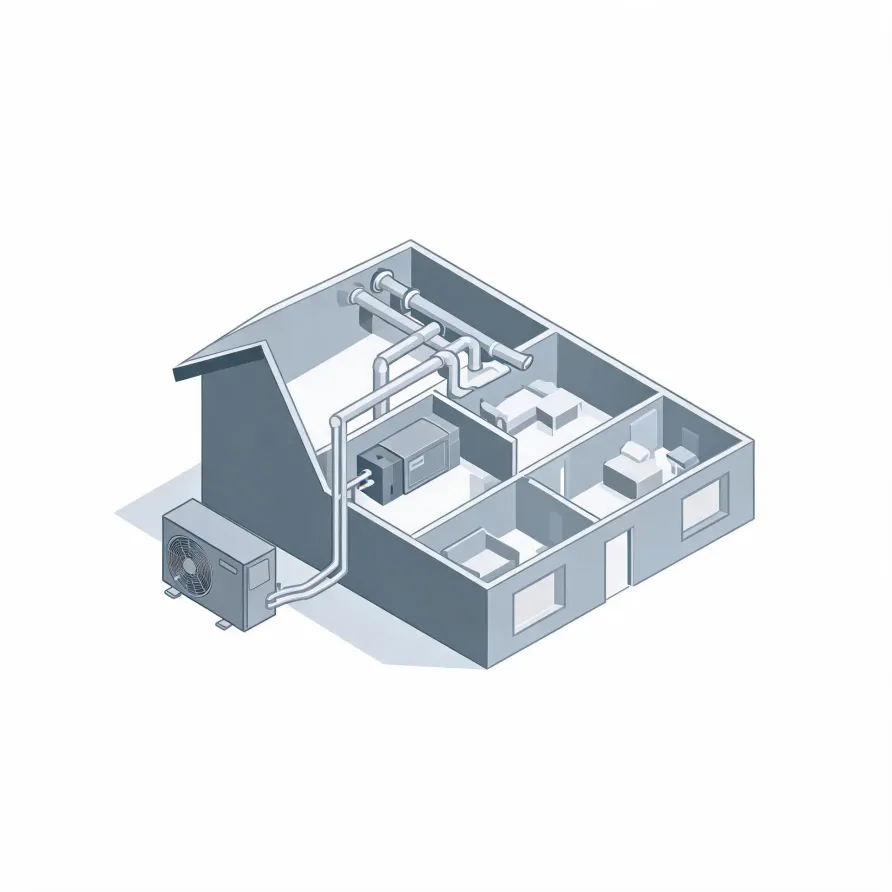
The outdoor unit is usually where a contractor starts. It houses the compressor, which is the heart of the system, along with the outdoor coil and a fan that pulls air across it. When the system is not heating or cooling properly, these components take the first look.
Inside the house, the air handler holds the indoor coil and a blower fan that moves conditioned air through the home. The reversing valve, which sits in the refrigerant line and tells the system which direction to run, is another piece a contractor checks when the heat pump is stuck in one mode or behaving unpredictably.
The drawing shows a representative layout, and a licensed contractor determines which components apply to the specific system and setup in your home.
Find a contractor in Brown CountyBrown County, Kansas, by the numbers
77 severe weather events were recorded in Brown County, Kansas between 2015 and 2024.
NOAA National Centers for Environmental Information, Storm Events Database, bulk CSV export, events 2015-01-01 through 2024-12-31.Half the homes in Brown County, Kansas were built in 1964 or earlier (2020-2024 ACS 5-year).
U.S. Census Bureau, 2020-2024 American Community Survey 5-Year EstimatesBrown County, Kansas holds 4,478 housing units (2020-2024 ACS 5-year).
U.S. Census Bureau, 2020-2024 American Community Survey 5-Year EstimatesOwners occupy 76.3% of the occupied homes in Brown County, Kansas (2020-2024 ACS 5-year).
U.S. Census Bureau, 2020-2024 American Community Survey 5-Year EstimatesSevere Weather Events in Brown County
Weather puts real stress on heat pump equipment. How hard a system works across a year depends partly on what the local climate throws at it, and that makes storm history a useful backdrop for understanding repair demand in Brown County.
77 severe weather events, 2015–2024. Source: NOAA National Centers for Environmental Information, Storm Events Database.