Tell us about the job
Takes about a minute. No obligation.
A heat pump compressor works in both directions, and in Johnson County it earns wear from both. Homes in Johnson County, KS run heat about seven months a year, from October through April. Across that stretch, the compressor starts and stops through heating demand in winter and cooling demand in summer, and the cumulative cycling is what a contractor sees when they pull the unit apart. Refrigerant charge, contactor condition, and coil fouling all shift with that kind of sustained use. A repair call here often turns up secondary wear on components that were holding on through the previous season.
Half the homes in Johnson County, Kansas were built in 1989 or earlier (2020-2024 ACS 5-year). For a heat pump sitting in a house from that era, the repair question a contractor has to answer is whether the parts the unit takes are still being made. Refrigerant lines, compressor components, and control boards from that generation of equipment are not always available through current supply chains. A contractor who opens the unit and finds a discontinued part has a different job than the estimate assumed.
The Parts of a Heat Pump a Contractor Checks First
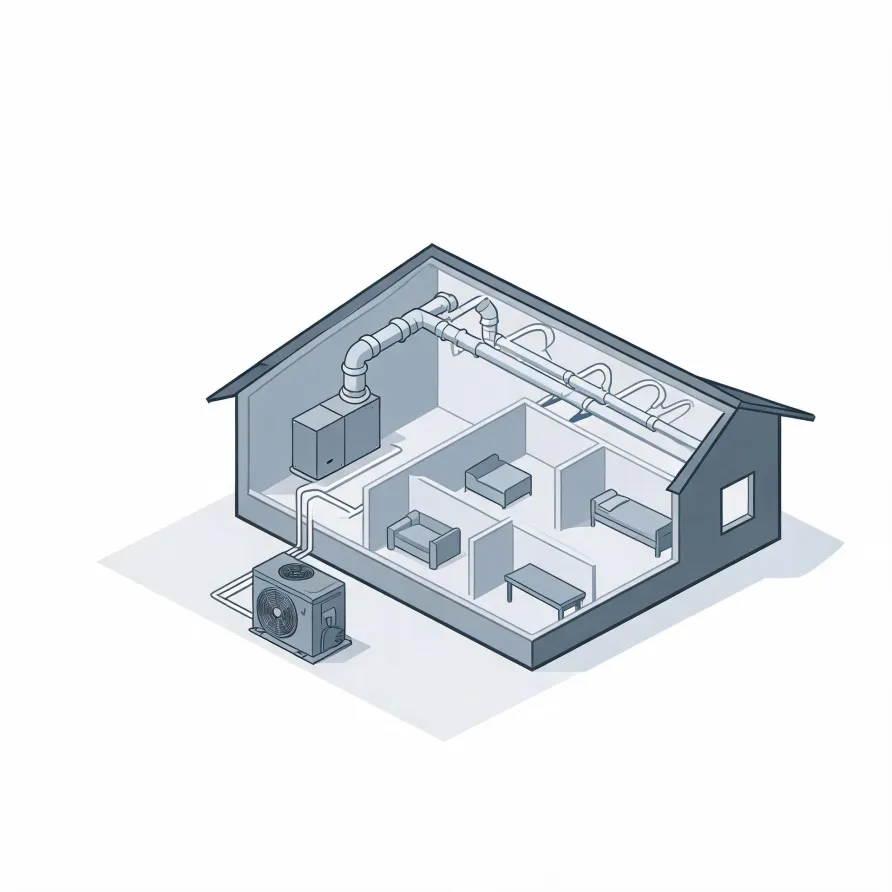
The outdoor unit sits on a pad beside the house and holds the compressor and the outdoor coil. The compressor is where most repair calls begin. When it fails, the system runs but moves no heat; when the outdoor coil is damaged or dirty, the same symptom shows up for a different reason.
Inside, the air handler hangs in a closet, attic, or mechanical room and contains the indoor coil, the blower fan, and the reversing valve that tells the system which direction to move heat. The expansion valve and the refrigerant lines connecting the two units are also points a contractor examines when the outdoor and indoor units both appear intact.
The drawing shows the general layout of a heat pump system, and a licensed contractor determines which components and conditions apply to your specific house.
Find a contractor in Johnson CountyJohnson County, Kansas, by the numbers
367 severe weather events were recorded in Johnson County, Kansas between 2015 and 2024.
NOAA National Centers for Environmental Information, Storm Events Database, bulk CSV export, events 2015-01-01 through 2024-12-31.Half the homes in Johnson County, Kansas were built in 1989 or earlier (2020-2024 ACS 5-year).
U.S. Census Bureau, 2020-2024 American Community Survey 5-Year EstimatesJohnson County, Kansas holds 259,655 housing units (2020-2024 ACS 5-year).
U.S. Census Bureau, 2020-2024 American Community Survey 5-Year EstimatesOwners occupy 68.5% of the occupied homes in Johnson County, Kansas (2020-2024 ACS 5-year).
U.S. Census Bureau, 2020-2024 American Community Survey 5-Year EstimatesSevere Weather Events in Johnson County
Extreme weather puts heat pumps under stress, and how hard the equipment works over time is shaped by what the local climate actually delivers. Repair needs in Johnson County reflect that history.
367 severe weather events, 2015–2024. Source: NOAA National Centers for Environmental Information, Storm Events Database.