Tell us about the job
Takes about a minute. No obligation.
A heat pump in Cloud County spends far more of its working life pushing heat in than pushing it out, and the refrigerant circuit and reversing valve carry that load unevenly. Homes in Cloud County, KS run heat about seven months a year, from October through April. The compressor cycles through cold air that reduces its capacity, which puts the defrost controls and backup heat strip under pressure that a mild-climate machine never sees. When a contractor diagnoses a fault here, the heating-side components get checked first, because that is where the hours accumulate.
Electrical service and refrigerant lines in a house this old have often been revised more than once, and what a contractor opens behind the disconnect or at the air handler reflects that layered history. Half the homes in Cloud County, Kansas were built in 1953 or earlier (2020-2024 ACS 5-year). A heat pump dropped into adapted infrastructure can run for years and then fail in ways that look like equipment problems until the wiring or line set gets traced. The repair scope a contractor quotes depends on which components belong to the current system and which were carried over from something earlier.
The Parts of a Heat Pump a Contractor Checks First
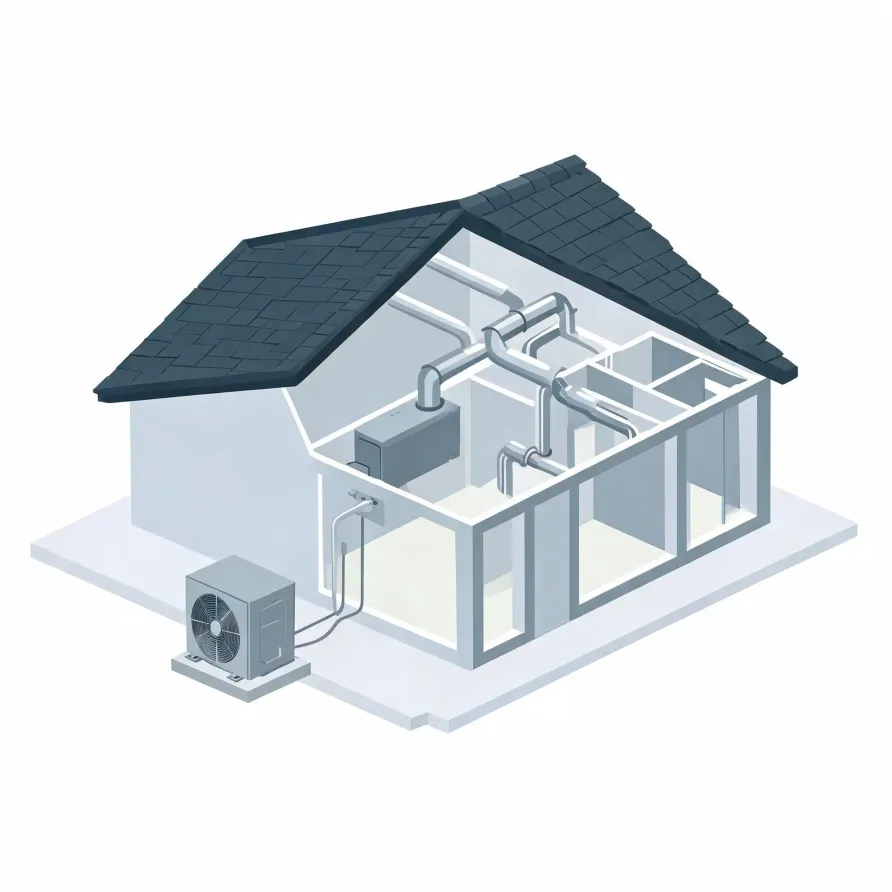
The outdoor unit sits outside the house and holds the compressor and condenser coil. These are where a contractor starts when a heat pump stops moving heat the way it should. A failed compressor, a refrigerant leak at the coil, or a seized fan motor in that cabinet are among the first things a technician looks for.
The air handler lives inside, usually in a closet, attic, or utility room, and circulates air across an indoor coil. The expansion valve, refrigerant lines, and the reversing valve that lets the system shift between heating and cooling all connect these two units and are each a possible source of trouble.
The drawing shows a representative layout, and a licensed contractor determines which parts apply to your specific system and home.
Find a contractor in Cloud CountyCloud County, Kansas, by the numbers
144 severe weather events were recorded in Cloud County, Kansas between 2015 and 2024.
NOAA National Centers for Environmental Information, Storm Events Database, bulk CSV export, events 2015-01-01 through 2024-12-31.Half the homes in Cloud County, Kansas were built in 1953 or earlier (2020-2024 ACS 5-year).
U.S. Census Bureau, 2020-2024 American Community Survey 5-Year EstimatesCloud County, Kansas holds 4,467 housing units (2020-2024 ACS 5-year).
U.S. Census Bureau, 2020-2024 American Community Survey 5-Year EstimatesOwners occupy 74.0% of the occupied homes in Cloud County, Kansas (2020-2024 ACS 5-year).
U.S. Census Bureau, 2020-2024 American Community Survey 5-Year EstimatesSevere Weather Events in Cloud County
Kansas weather puts heat pumps through real work. How hard the equipment runs, and how often it strains under sudden shifts in demand, is shaped by what the local sky does year to year, which is why that record matters for repair decisions in Cloud County.
144 severe weather events, 2015–2024. Source: NOAA National Centers for Environmental Information, Storm Events Database.